

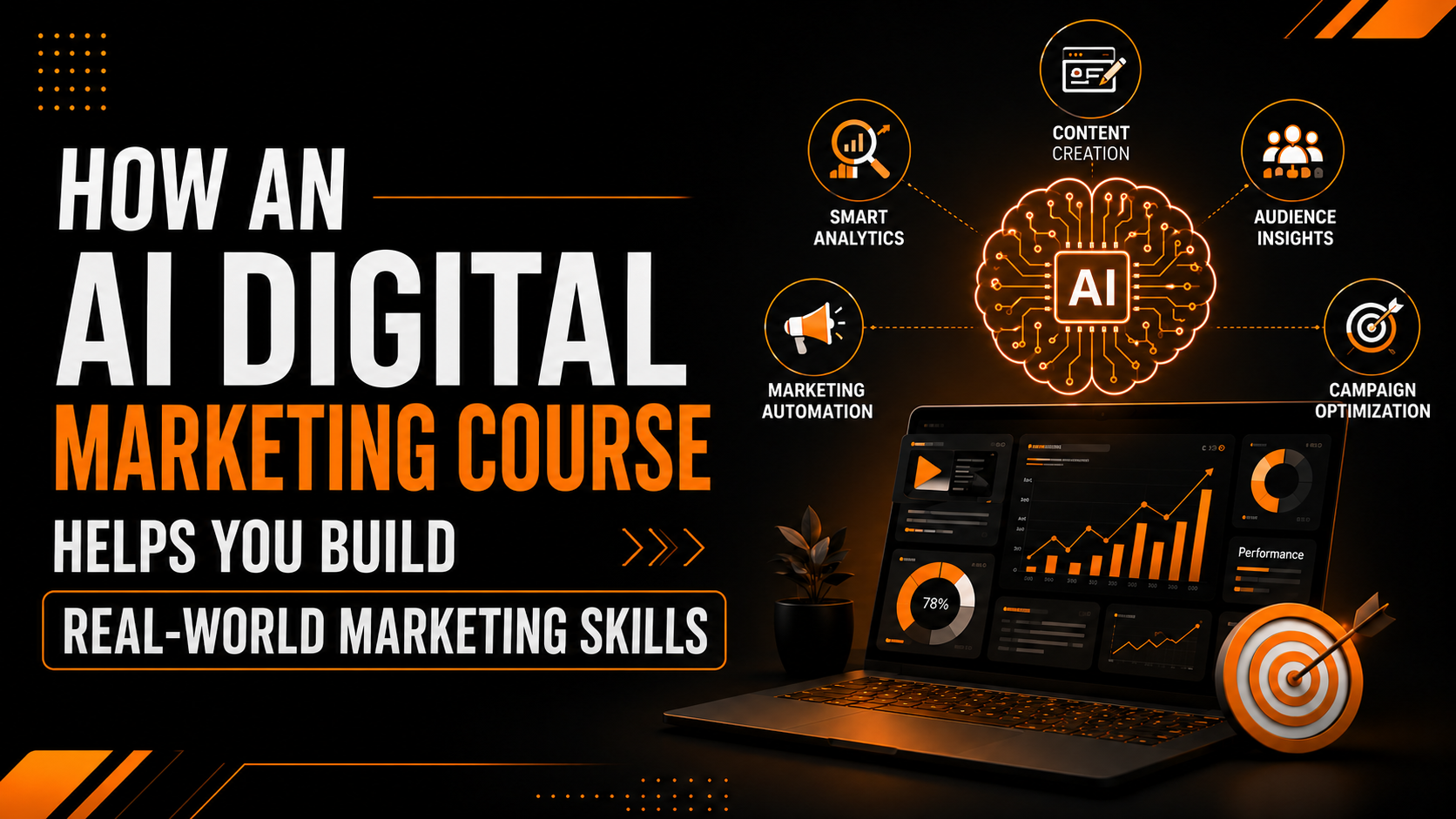
AI digital marketing course training is becoming increasingly valuable for students, professionals, and business owners who want to develop practical marketing skills. Digital marketing is no longer limited to creating social media posts or running advertisements. Modern marketers need to understand data, search engines, content creation, automation, customer behaviour, and performance analytics.
Learning how to combine artificial intelligence with digital marketing can help learners work more efficiently, make data-driven decisions, and adapt to the rapidly changing digital landscape. More importantly, practical training can help turn theoretical knowledge into skills that can be applied to real marketing campaigns.
Artificial intelligence is transforming many areas of digital marketing. Marketers can use AI to generate content ideas, analyse customer behaviour, identify trends, optimise campaigns, and automate repetitive tasks.
A good course introduces learners to practical applications of AI rather than focusing only on theory. This helps students understand where AI can support marketing activities and where human creativity and strategic thinking remain important.
Search engine optimisation is one of the most important digital marketing skills. AI can assist marketers with keyword research, content planning, competitor analysis, search intent analysis, and content optimisation.
Through practical assignments, learners can understand how to select relevant keywords, structure content, optimise pages, and monitor SEO performance. These skills can be applied to websites, blogs, ecommerce stores, and business campaigns.
Creating useful and engaging content is essential for attracting and retaining an online audience. AI tools can help marketers brainstorm topics, create content outlines, improve copy, and identify opportunities for content development.
However, effective content marketing requires more than simply generating AI-written content. Learners need to understand audience needs, brand messaging, storytelling, search intent, and content strategy.
Social media marketing provides another area where practical experience is extremely valuable. Learners can develop skills in content planning, audience research, campaign creation, engagement strategies, and performance analysis.
Using AI tools alongside social media platforms can help marketers identify content opportunities, generate creative ideas, and improve campaign workflows while maintaining a consistent brand voice.
Digital advertising requires marketers to understand targeting, creatives, budgets, conversions, and performance metrics.
Practical learning can help students understand how advertising campaigns are structured and how campaign data can be used to make better decisions. AI can assist with analysing performance patterns, testing creative variations, and identifying potential areas for optimisation.
Data plays an important role in modern marketing. Marketers need to understand metrics such as impressions, clicks, engagement, conversion rates, traffic, and return on advertising spend.
An AI digital marketing course can introduce learners to tools and techniques that make it easier to analyse marketing data and identify meaningful insights. This helps learners move beyond assumptions and make decisions based on measurable results.
Automation allows marketers to reduce repetitive tasks and spend more time on strategy and creativity. AI can support activities such as content workflows, customer communication, lead management, reporting, and campaign analysis.
Understanding automation gives learners a valuable skill that can be useful in agencies, startups, ecommerce businesses, and in-house marketing teams.
One of the biggest advantages of practical digital marketing education is the opportunity to work on realistic projects.
Instead of only studying concepts, learners can practise developing campaigns, researching audiences, creating content, analysing competitors, optimising websites, and reviewing campaign performance.
Project-based learning can also help students build a portfolio that demonstrates their abilities to potential employers or clients.
Technology alone cannot create an effective marketing strategy. Marketers still need to understand business objectives, customer problems, competition, positioning, and communication.
AI can provide information and recommendations, but marketers must evaluate the results and make strategic decisions. Learning to combine AI capabilities with human judgement is therefore an important professional skill.
The digital marketing industry continues to evolve as businesses adopt new technologies and platforms. Professionals who understand both traditional marketing fundamentals and AI-powered tools can adapt more effectively to these changes.
An AI digital marketing course can therefore help learners develop a combination of technical, creative, analytical, and strategic skills that are useful across different digital marketing roles.
Where to Learn More About AI
For additional information about artificial intelligence and its applications, learners can explore the Google AI resources and learn more about how AI is being developed and applied across different fields.
Building real-world digital marketing skills requires more than learning definitions and concepts. Learners need opportunities to practise SEO, content marketing, social media, paid advertising, analytics, automation, and campaign strategy.
Combining these skills with AI can help aspiring marketers work more efficiently and approach marketing challenges with greater confidence. Practical projects, hands-on assignments, and continuous learning can make digital marketing education more relevant to today’s rapidly changing business environment.
An AI digital marketing course teaches digital marketing fundamentals while showing learners how artificial intelligence can be used for activities such as SEO, content creation, social media, advertising, analytics, and marketing automation.
Yes. Beginners can start with digital marketing fundamentals and gradually learn how AI tools can support research, content creation, campaign planning, analytics, and other marketing activities.
AI can help marketers analyse data, generate ideas, automate repetitive tasks, identify trends, support content creation, and improve campaign workflows. Human judgement and strategic decision-making are still important for achieving business goals.